The Golden Age of Norrath
A brief history of EverQuest — the game that changed everything
I. The World That Started It All
On March 16, 1999, Sony Online Entertainment released EverQuest into a world that had never seen anything like it. The internet was barely mainstream. Broadband was a luxury. And yet thousands of players — paying monthly subscription fees, running 56K modems, and enduring loading screens measured in minutes — poured into the world of Norrath and never left.
EverQuest wasn't the first massively multiplayer online role-playing game, but it was the first to feel genuinely massive. Sprawling zones, brutal difficulty, no hand-holding, and a social fabric that forced players to cooperate or die — it was a phenomenon. At its peak it held over 500,000 subscribers and established every convention that online RPGs have followed ever since.
Ruins of Kunark (2000)
The first expansion arrived in April 2000 and shattered expectations. Ruins of Kunark added an entirely new continent — Kunark — home to the reptilian Iksar race and the legendary Dragon Necropolis. It raised the level cap to 60, introduced some of the most iconic raid encounters in EQ history, and more than doubled the size of the world. Players who had been playing for a year suddenly had as much new content as they'd had at launch.
Kunark also introduced Epic Weapon quests — one for each class, each a sprawling multi-step journey involving rare drops, faction grinding, and cooperation from guilds and strangers alike. Completing your Epic was a rite of passage: proof of dedication, community, and no small amount of luck. The weapons themselves were class-defining and carried a prestige that later gear never quite replicated. Many players still remember exactly where they were when they finished theirs.
Scars of Velious (2000)
Just eight months later came Scars of Velious — the frozen continent of Velious, home to dragons, giants, and the Coldain dwarves locked in endless war. Velious is widely remembered as one of EverQuest's creative peaks: the Temple of Veeshan, the Sleeper's Tomb, and faction-based alliances that made every player's server history uniquely their own. Velious cemented the idea that EverQuest wasn't just a game — it was a living world with a history players were writing themselves.
Shadows of Luclin (2001)
Shadows of Luclin took the franchise to EverQuest's moon — and divided the playerbase. New graphics models, a cat-like player race (the Vah Shir), and the Nexus — a central hub zone with teleportation spires connecting the continents — all landed with a thud for many veterans. The faster travel network made the world feel smaller. For some, Luclin was modernization. For others, it was the first step away from what made EverQuest special.
The argument never fully resolved — but EverQuest kept going. After more than twenty-five years of continuous operation, the game launched its 32nd expansion, Shattering of Ro, in late 2025. Norrath endures.
II. The Golden Era — Planes of Power & Lost Dungeons of Norrath
If Velious was EverQuest's creative peak, Planes of Power (October 2002) was its raiding peak. The premise was audacious: the gods themselves had grown too powerful, and the players of Norrath were going to go kill them. Literally.
PoP introduced a tiered planar progression system — Plane of Justice, Plane of Disease, Plane of Storms, Plane of Tactics, and dozens more — that culminated in the Plane of Time. ToV-era guilds that had spent years farming dragons now spent months methodically clearing planes, unlocking access to the next tier, and eventually stepping into the Plane of Time itself to battle Quarm, the four-faced avatar of the gods' combined power. It was the closest thing EverQuest ever produced to a true final boss.
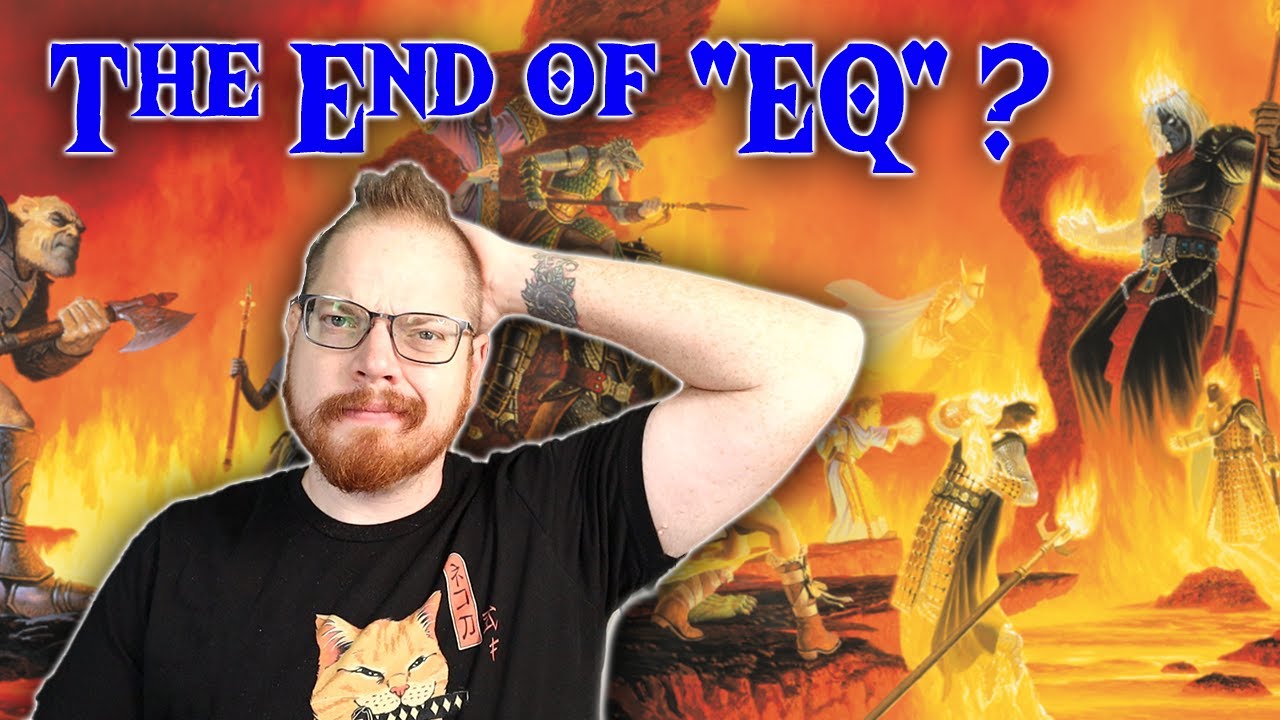
Did Planes of Power kill EverQuest? A retrospective on the expansion that defined — and arguably ended — the golden age. (Opens on YouTube)
The debate in the video above is real: PoP's Plane of Knowledge and instant teleportation network made the world radically more accessible, eliminating the danger and social necessity of open-world travel. Whether that was good game design or the beginning of EverQuest's decline as a community game is a question the playerbase still argues. What's beyond dispute is that PoP-era raiding — the progression, the difficulty, the social bonds forged in 72-person raids — represents the apex of what EverQuest was capable of.
Lost Dungeons of Norrath (2003)
Released alongside PoP's final patches, Lost Dungeons of Norrath introduced instanced group dungeons — a first for EverQuest. Rather than competing for camps in an open world, groups of six adventurers could enter their own private dungeon instance and run it start to finish. LDON also introduced the Adventure Point economy and a tiered augmentation system, letting players gradually gear up through group content in ways that hadn't existed before.
The augments — particularly the raid-tier drops from LDON's deepest dungeons — were something special. Many carried Heroic stats: Heroic Strength, Dexterity, Agility, and more. These weren't just numbers. Heroic STR added raw damage bonus to every hit; Heroic DEX pushed proc rates and precision; Heroic AGI stacked into avoidance AC that tanks couldn't get anywhere else. Slotted into the aug slots built into Plane of Time gear, they transformed already-godly raid equipment into something genuinely absurd. A Quarm chest piece was already best in slot. A Quarm chest piece with a Heroic DEX aug socketed into it was a different category of item entirely.
LDON arrived at an inflection point. EverQuest 2 and World of Warcraft were both on the horizon. The instanced dungeons and progressive gear system it introduced would become standard features of every major MMO that followed — a template the genre still uses today. But for those who lived through the PoP/LDON era, the memory isn't of templates or genre conventions. It's of late nights in the Plane of Time, of server firsts, of guilds that felt like families.
III. Agnarr — The Server That Froze Time
On May 24, 2017, Daybreak Game Company launched a new True-Box Time-Locked Progression server called Agnarr. The premise was simple: the server would progress through EverQuest's expansions at its own pace, and then — unlike every other TLP server — it would stop. Agnarr was designed from day one to lock permanently at the Planes of Power / Lost Dungeons of Norrath era.
For a certain kind of EverQuest veteran, this was the dream. No sprawling toward later expansions that diluted what made EQ special. No rushing past content everyone loved. Just the game, frozen at its peak — permanently.
True-Box rules required each player to run only one account per physical machine, reducing the rampant multiboxing that had hollowed out the community feel on other servers. The result was a server that, even years later, retained an unusually tight-knit raiding scene.
As of 2026, Agnarr remains active with two established raiding guilds carving through the Plane of Time week after week: Charge the Lair and Adventure Time. The gods haven't rested. Neither have we.
IV. The Domains Come Home
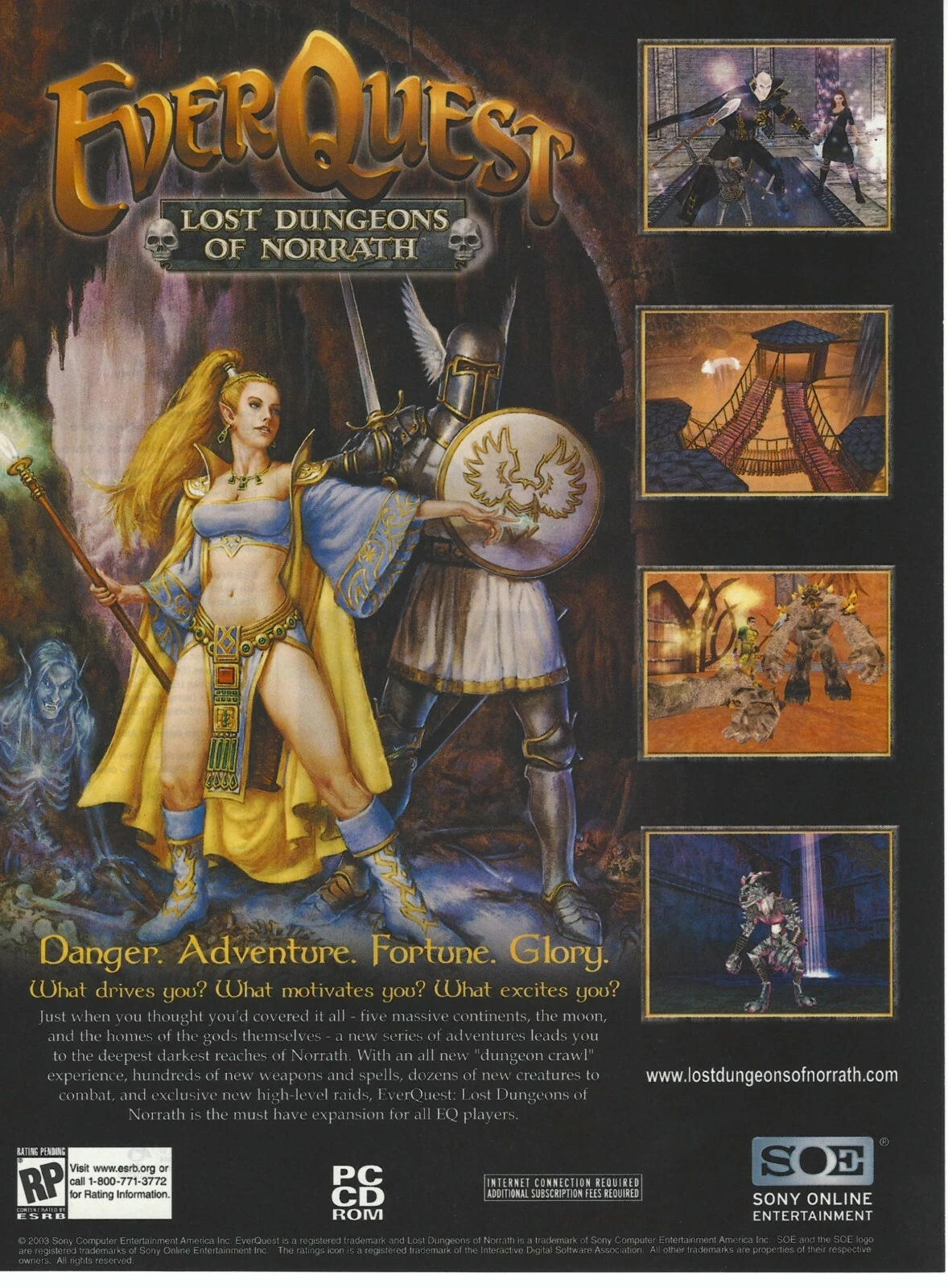
The original 2002 LDON promotional poster. Note the domain in the lower right.
When Sony Online Entertainment launched Lost Dungeons of Norrath in October 2003, they registered lostdungeonsofnorrath.com as the official companion site. The domain appears on the promotional poster above — a relic from an era before social media, when a game's website was its primary presence. The official SOE site is long gone, but the domain survived.
Similarly, planesofpower.com was registered to accompany the Planes of Power expansion — the companion site for the expansion that took players to the homes of the gods. Like its LDON counterpart, the SOE content has long since vanished.
Both domains have now found a new home. Adventure Time, raiding the Plane of Time on Agnarr in 2026, now owns lostdungeonsofnorrath.com and planesofpower.com. Two domains tied to the golden era of EverQuest, sitting untouched for over two decades, have returned to the game they were named for — and to players still living in that era.
These aren't nostalgia projects. We're actively raiding. The loot listed in the BiS guide are the items we spend our hard-earned DKP on. The Plane of Time is not a museum exhibit — it's Thursday night.
If you're on Agnarr and looking for a home, or if you just want to argue about whether PoP killed EverQuest, you know where to find us.